Calorie Counting vs. Intuitive Eating: Which Actually Works?

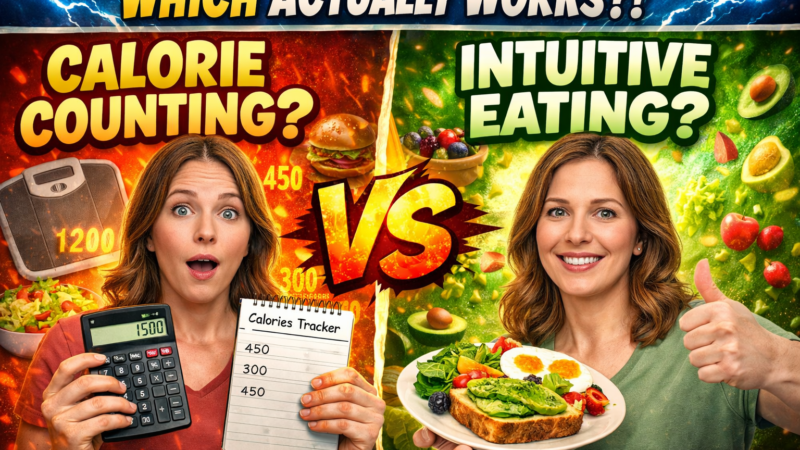
I tried both. One nearly broke me. The other saved me. Here is the whole truth.
I still remember the night I sat on my kitchen floor at 11:47 PM, crying over a bowl of cereal. Not because I was sad. Not because something terrible had happened. But because that bowl of Cheerios was 110 calories, and I had already used up my daily allowance of 1,400. I had been counting calories for four months straight. I had lost 9 kilos. And I had never been more miserable in my life.
Let me back up. Like most people who have ever Googled “how to lose weight,” I started with calorie counting. It made perfect sense on paper. Calories in, calories out. Simple math. Download an app, scan your food, stay under your number. The logic was clean, almost elegant. And for the first few weeks, it felt like I had finally cracked the code.
I weighed everything. Chicken breast on a food scale. Olive oil measured by the teaspoon. I logged every apple, every handful of almonds, every splash of milk in my tea. I became fluent in the caloric value of common foods the way some people memorize cricket stats. A banana? About 105. A roti? Around 120. Two tablespoons of peanut butter? 190. I could calculate a meal in my head faster than I could enjoy it.
And the weight came off. Steadily. Predictably. My clothes got looser, people started commenting, and I felt a quiet thrill every morning stepping on the scale. This was working. I was in control.
Except I was not in control. The app was.
Slowly, without my noticing, calorie counting had stopped being a tool and started being a cage. I declined dinner invitations because I could not calculate restaurant food accurately enough. I ate the same five meals on rotation because their calorie counts were memorized and safe. I started feeling anxious around food I had not prepared myself. A coworker brought homemade cake for her birthday, and I sat at my desk pretending I was not hungry while my stomach growled. I knew approximately how many calories were in a slice. But “approximately” was not good enough anymore.
I had turned eating into an arithmetic problem, and somewhere along the way, I had subtracted all the joy.
The breaking point was that night on the kitchen floor. I realized I was not eating cereal because I was hungry. I was eating it because I had spent the entire day so focused on staying under my number that by nighttime, my body was screaming for fuel. I was not listening to my body at all. I was listening to an app.
That is when a friend told me about intuitive eating. I will be honest: my first reaction was skepticism. “Just eat when you are hungry and stop when you are full” sounded like the kind of advice that gets printed on a motivational poster and ignored. It sounded too simple, too vague, too much like giving up.
But I was exhausted. So I tried it. I deleted MyFitnessPal. I put the food scale in a drawer. And for the first two weeks, I panicked.
Without numbers telling me what to do, I felt lost. I overate at almost every meal. I had pasta and then ice cream and then more pasta. Part of me was terrified I would gain back everything I had lost. And honestly? I gained about 2 kilos in that first month. It felt like proof that intuitive eating was a scam.
But something my friend said kept echoing in my head: “Your body has been starved of trust. Of course it is going to overcompensate at first. Give it time.”
So I gave it time. I started paying attention to things I had been ignoring for months. How food actually tasted when I was not calculating it. How my stomach felt at different levels of fullness. The difference between eating because I was hungry and eating because I was bored, or stressed, or lonely. These were things no calorie counter had ever taught me.
By the third month, something shifted. The frantic overeating stopped. I started naturally gravitating toward meals that made me feel good, not just meals that fit a number. I ate more vegetables, not because they were low calorie, but because I genuinely felt better when I did. I stopped at one slice of cake without a battle in my head because I was actually satisfied, not because an app told me to stop.
And slowly, the weight started coming off again. Not as fast as before. Not in a clean, predictable line on a graph. But it came off. And this time, I was not crying on any floors.
So which one works? Here is my honest answer: both. And neither. It depends entirely on who you are and where you are in your journey.
Calorie counting taught me things I genuinely needed to learn. Before I tracked, I had no idea how calorie-dense cooking oil was, or how small a real serving of rice looked, or that my “healthy” smoothie had more calories than a cheeseburger. That awareness was valuable. It was education I did not have before.
But calorie counting could not teach me when I was actually hungry. It could not teach me why I ate an entire bag of chips every Sunday night. It could not repair my relationship with food, because it was never designed to. It is a measuring tool, not a healing one.
Intuitive eating gave me something calorie counting never could: peace. The ability to sit at a dinner table with friends and just eat. To taste my food. To trust my body again, even when that trust felt terrifying. It taught me that my body is not an enemy to be outsmarted with math. It is a partner that has been trying to communicate with me my entire life. I just was not listening.
If calorie counting was the map, intuitive eating was learning to read the terrain with my own eyes.
If you are just starting out and you truly have no idea how much you are eating, a few weeks of tracking can be eye-opening. But set a time limit. Use it as a course, not a lifestyle. Learn what you need to learn, and then put the calculator down.
And if you are where I was, exhausted and anxious and weighing cereal at midnight, please hear me: there is another way. It is messier. It is slower. It does not come with a neat daily score or a progress bar. But it works. Not just on your body. On your whole self.